
First Nations Measurement & Evaluation Platform

The Wathaga project is a great example of what AiGILE does best — taking a complex, meaningful challenge and turning it into a working product using AI at every stage. From strategy through to delivery, we used our AiGILE development process to design and build a full SaaS platform that would have traditionally taken far longer and cost far more.
Building Wathaga
A Measurement & Evaluation Platform That Puts First Nations Communities in Control
The Challenge
Kowa Collaboration had a bold vision: build a digital platform that could genuinely serve First Nations communities in measuring and evaluating the impact of their programs and initiatives.
But here's the thing — most M&E platforms are built around spreadsheets and structured surveys. They assume data comes in neat rows and columns. That's not how communities share what matters. Stories, artwork, group conversations captured on video — these are rich, meaningful forms of data that traditional platforms simply can't handle. On top of that, existing data was often scattered across disparate locations, data sovereignty existed more at an academic level than a practical one, and the cost of quality evaluation was putting it out of reach for many.
Kowa needed a platform that could embrace all of that, make sense of it, and do so while keeping communities firmly in control of their own data through Indigenous Data Sovereignty and Governance.

What We Built
We partnered with Kowa to design and build Wathaga from the ground up — from initial concept through to a fully operational SaaS platform.
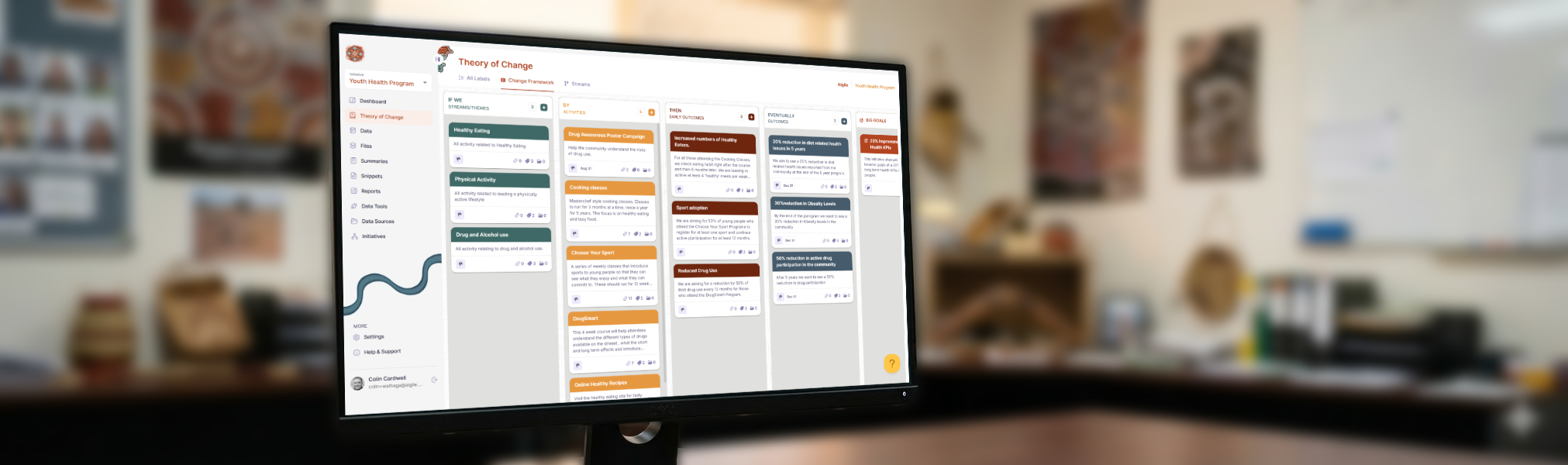
At its core, Wathaga is built around an innovative Theory of Change labelling system that lets all collected data — structured or unstructured — be organised and understood in the context of a program's intended impact. Kowa calls this the "Wisdom Tapestry" approach: bringing together diverse evidence across deep knowing, story, artifact, being, and deep listening to enable rich collective sense-making.
From there, we built out a comprehensive feature set including a flexible file upload and management system supporting most file types, a Data Tool builder for creating custom structured data collection forms and imports, AI-powered data summarisation across datasets, video and audio transcription tools powered by AI — supporting Aboriginal English, Aboriginal dialects, and standard English, a snippet tool for pulling key moments from files into reports, and a full report creation suite.
Underpinning everything is a built-in Indigenous Data Governance framework ensuring communities remain the owners of their data — not the platform, not the funder, not anyone else. All data is stored and retained within Australia, and critically, no data is shared with or used to train large language models. AI is wrapped at the initiative level, protecting potentially sensitive or sacred data.
We also delivered all visual design, user experience flows, secure authentication, a subscription and billing system, and a comprehensive admin system. Kowa also offers a free plan for communities and initiatives with minimal budgets — reflecting their belief that keeping data safe is a fundamental right.

How We Built It
AI played a significant role throughout the project — not just in the platform's features but also in how we built it. From project management and development through to testing, our AiGILE process enabled us to deliver a feature-rich platform efficiently without compromising on quality.
The platform runs on a modern stack: a Node.js API, a React front-end, MongoDB for the database, and AWS for hosting.
The Results
Since launch, Wathaga has attracted a growing base of active subscribers generating valuable recurring revenue for Kowa. The platform has been warmly received by communities, practitioners, and funders alike.
Early adopters are already using Wathaga in diverse ways — from tracking a junior ranger program's delivery through teacher observations, curriculum links, and attendance data, to centralising years of scattered data collections into a single secure repository. One user reported that Wathaga's AI thematic analysis produced results closely matching their own independent assessment — a strong validation of the platform's analytical capability.
Most importantly, Wathaga is doing what it was designed to do: giving First Nations communities the tools to tell their own story, measure their own impact, and keep control of their own data.